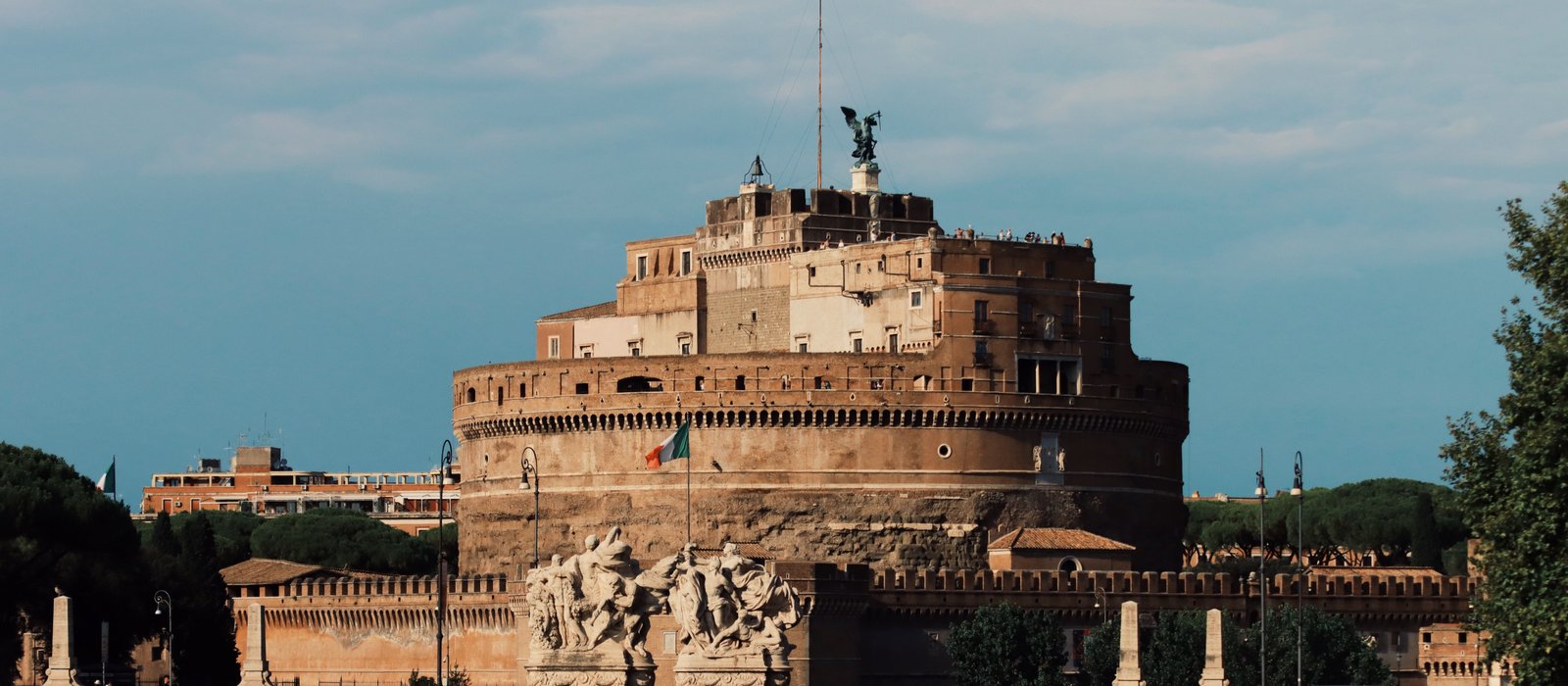
Few buildings in Rome have lived as many lives as Castel Sant'Angelo. It began as an emperor's tomb, became a fortress, served as a papal refuge, a prison, and a barracks, and is now a museum crowned by one of the best rooftop views in the city. Standing dramatically on the Tiber a short walk from St. Peter's — and connected to the Vatican by a secret elevated corridor used by popes fleeing for their lives — it's a genuinely thrilling stop that pairs naturally with a Vatican visit. Here's what to know before you go.
A quick history (it explains everything you'll see)
The building's strange, stacked appearance makes sense once you know its story:
A mausoleum (139 AD): Emperor Hadrian built it as a colossal cylindrical tomb for himself and his successors — the cylindrical Roman core you still see at the base.
A fortress: as the empire fell, the mausoleum was fortified into a stronghold guarding the river crossing.
A papal refuge: in 1277 a popes built the Passetto di Borgo, an 800-meter elevated corridor linking the castle to the Vatican, so they could flee there in danger. Pope Clement VII famously used it to escape the 1527 Sack of Rome, holing up in the castle for a month.
Its name: "Castle of the Holy Angel" comes from a 590 AD legend in which Pope Gregory the Great saw the Archangel Michael sheathing his sword atop the building, signaling the end of a plague. A bronze statue of Michael crowns the summit today.
A prison, then a museum: it later held prisoners (including the sculptor Cellini) before becoming the national museum it is now.
What to see inside
The visit spirals upward through the building's layers:
- Hadrian's original Roman walls at the base, and the spiral ramp built for the ancient funeral procession.
- The papal apartments — surprisingly lavish Renaissance rooms, decorated for popes sheltering in style.
- The prison cells and dungeons.
- The Terrace of the Angel at the top — the highest point, beneath the bronze Michael, with a sweeping 360° panorama over Rome and straight down the angel-lined Sant'Angelo Bridge toward St. Peter's. This rooftop view is, for many, the highlight.
Don't rush the climb — each level is a different century.
Tickets and hours
Open Tuesday–Sunday, roughly 9:00 am to 7:30 pm (last entry around 6:30 pm), closed Mondays and on Dec 25 / Jan 1. Confirm current hours when you go.
Tickets are single-entry; book online ahead in peak season to skip ticket lines (security screening still applies to everyone).
The price is moderate — check the current rate. First Sunday of the month is free (and busier), and the Roma Pass is accepted.
Summer night openings ("Notti al Castello," roughly early July to early September) let you visit in the evening with the terrace beautifully lit — a special experience worth seeking out if your trip aligns.
The Passetto di Borgo — the secret papal corridor
The castle's most romantic feature is the Passetto di Borgo, the fortified escape corridor running along the top of a wall from the castle to the Vatican. Crucial practical point: the standard ticket does not include the Passetto. Walking it requires a specific guided "Passetto" tour or combo ticket (look for "Passetto" in the title), which adds a modest amount and includes an accompanied walk along the corridor (and often the San Marco bastion). These guided slots run on selected days published on the official calendar and sell out well ahead in summer, so book two to three weeks out in peak season. The corridor is narrow, partly roofed, and the floor is uneven — wear flat shoes.
A neat trick if you're combining with the Vatican: some Passetto tours exit at the Vatican-side gate, leaving you right by St. Peter's Square.
Is it worth your time?
An honest placement for a first visit: Castel Sant'Angelo is a second-tier-but-wonderful stop. On a tight two- or three-day trip focused on the Colosseum, Forum, and Vatican, it's an optional add rather than a must — but it's one of the best optional adds in Rome, especially because it pairs so efficiently with the Vatican (which is right there) and delivers a rooftop view that rivals any in the city. If you have four or more days, it earns a confident place on the list. And if you're even slightly a history enthusiast, the sheer layering — Roman tomb to medieval fortress to Renaissance papal apartments to prison to museum, all in one spiral climb — is hard to beat for the time it takes. The Ponte Sant'Angelo approach is worth lingering on too: Bernini designed the program of angel statues lining the bridge (his workshop carved most; a couple of originals are preserved elsewhere), each angel holding an instrument of the Passion — a dramatic, theatrical approach to a dramatic, theatrical building.
How to combine it with your Vatican day
Castel Sant'Angelo sits between the historic center and the Vatican, so it pairs beautifully:
- With St. Peter's and the Vatican Museums — it's a short walk from St. Peter's Square; many people do the Vatican in the morning and the castle in the afternoon (or vice versa).
- Cross the Ponte Sant'Angelo — the pedestrian bridge to the castle is lined with Bernini's dramatic angel statues, lovely at golden hour.
- End on the terrace for sunset views over the river and St. Peter's dome.
Practical tips
Expect multiple staircases — there's a partial lift, but the upper levels and terrace involve stairs; not ideal for limited mobility (contact the museum about access).
Allow 1.5–2 hours (more with the Passetto tour).
Security screening applies — travel light.
Golden hour on the terrace is the move for the best photos.
The bottom line
Castel Sant'Angelo packs two thousand years — emperor's tomb, fortress, papal bolt-hole, prison, museum — into one dramatic riverside building, topped by one of Rome's finest rooftop panoramas. Book a single-entry ticket ahead (first Sunday free, Roma Pass accepted), climb through its layered history to the Terrace of the Angel, and if you want the famous secret corridor, book the separate guided Passetto tour two to three weeks ahead. Pair it with your Vatican visit across Bernini's angel bridge, and you've got one of Rome's most rewarding — and underrated — half-days.