Two of Rome's most prominent landmarks sit side by side and confuse almost every first-timer: the Capitoline Hill (Campidoglio), the ancient and most sacred of Rome's seven hills, redesigned by Michelangelo into one of the world's great public squares — and the Vittoriano (Altare della Patria), the colossal white marble monument that dominates Piazza Venezia and which Romans have nicknamed everything from "the wedding cake" to "the typewriter." They're next to each other, easy to combine, and both offer something special — including some of the best free (and near-free) views in Rome. Here's how to make sense of them.
The Capitoline Hill (Campidoglio)
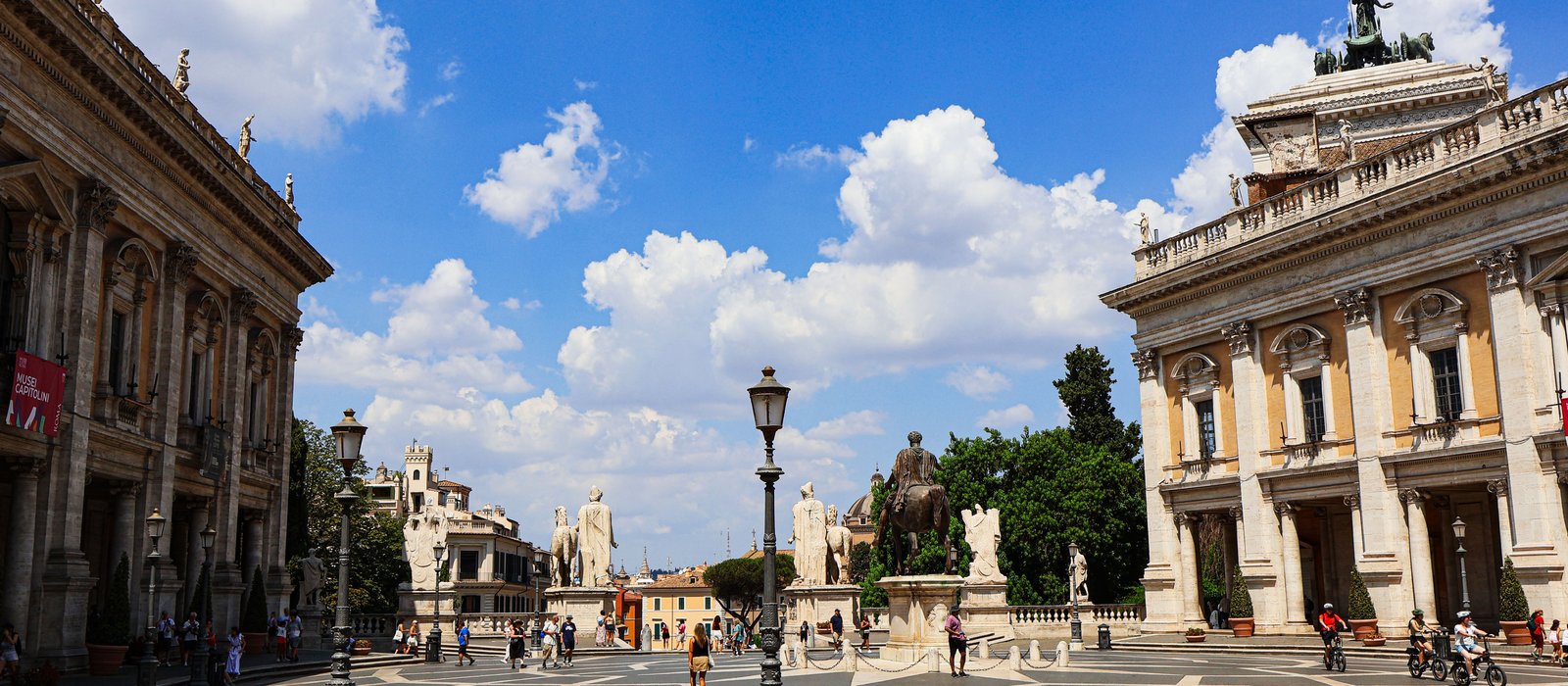
The Capitoline was the religious and symbolic heart of ancient Rome — home to the great Temple of Jupiter, where triumphs culminated and the city's most sacred rites took place. The word "capitol" itself descends from it. Today its glory is Piazza del Campidoglio, the piazza Michelangelo designed in the 16th century: a beautifully proportioned square with a geometric star-patterned pavement, framed by palaces, reached by Michelangelo's gentle stepped ramp (the Cordonata). At its center stands a replica of the ancient equestrian statue of Marcus Aurelius (the original is safely inside the museums).
- The piazza itself is free to walk up to and enjoy — and it's stunning, especially in the late-afternoon light.
- The view behind it: from the terrace beside the piazza (near the Tabularium / the side toward the Forum), you get one of the best free panoramas over the Roman Forum in the city — a perfect way to orient yourself before or after visiting the Forum itself.
- The Capitoline Museums flank the square (covered in our dedicated museums guide) — the world's oldest public museums, well worth a visit if you have time, but a separate ticketed experience from simply enjoying the hill.
The Vittoriano (Altare della Patria)
Right next door, impossible to miss, is the vast white monument built around 1900 to honor Italy's first king, Victor Emmanuel II, and the unification of Italy. It also holds the Tomb of the Unknown Soldier, guarded around the clock — a solemn national shrine, so visitors should be respectful.
Romans have famously mixed feelings about it (hence the affectionate mockery — "the wedding cake," "the typewriter"), since its gleaming bulk clashes with the ancient surroundings. But for a visitor it delivers two things:
- It's free to climb the main terraces and steps, and the monument is genuinely impressive up close.
- The views are spectacular. The upper terraces give a sweeping panorama over Rome's rooftops, and for the very best view there's a glass panoramic lift (the Terrazza delle Quadrighe) to the top — a modest paid ticket for arguably the finest 360° view in central Rome, looking straight down the Via dei Fori Imperiali toward the Colosseum.
Inside, the Vittoriano also houses museums and frequently hosts exhibitions.
Why these two confuse everyone
It's worth clearing up the mix-up directly, because nearly every first-timer makes it. The Vittoriano is the enormous, gleaming-white monument you can't miss from Piazza Venezia — it's barely over a century old, built for modern unified Italy, even though its grandiose style apes ancient temples. The Capitoline Hill rises right behind and beside it and is the genuinely ancient, sacred hill, with Michelangelo's Renaissance square on top. So you have "the giant white wedding cake" (Vittoriano, modern) next to "the elegant star-paved piazza up the ramp" (Campidoglio, ancient hill + Michelangelo). They're neighbors, easily confused at a glance, and easily done together — but they're from completely different eras, which is exactly why the white monument looks so jarring against everything around it. Knowing which is which makes the whole Piazza Venezia area click into place.
How to visit them together
The two sit essentially side by side at Piazza Venezia, the busy hub at the center of Rome, so they combine perfectly into a short, high-reward stop:
- Start at Piazza Venezia and the Vittoriano — climb the terraces (free) or take the panoramic lift for the view.
- Walk up the Cordonata ramp to Michelangelo's Piazza del Campidoglio.
- Step to the Forum-overlook terrace for the free panorama down into the ancient Forum.
- Optionally, visit the Capitoline Museums if you want the art and antiquities.
It's also superbly located: you're a few minutes' walk from the Forum/Colosseum on one side and the historic center (Pantheon, Piazza Navona) on the other, so this pairing slots naturally into a day connecting ancient Rome with the centro storico.
Practical tips
- The piazzas and terraces are free; only the museums and the Vittoriano's top-level panoramic lift are ticketed (check current prices).
- Best light: late afternoon and golden hour are gorgeous up here.
- Be respectful at the Tomb of the Unknown Soldier — no sitting on the steps near it, and follow posted rules.
- Some steps involved at both — the Cordonata is gentle, but the Vittoriano has staircases (the lift helps for the top).
- Great orientation stop: because of the Forum overlook and the rooftop panoramas, this is an ideal first stop to get the lay of ancient Rome before diving in.
- Combine with what's next door: you're minutes from the Forum/Colosseum to the south and the Pantheon/Piazza Navona to the north, so this pairing is the natural hinge between ancient Rome and the historic center — slot it between the two rather than as a separate trip.
- Watch for the changing of the guard at the Tomb of the Unknown Soldier — a small, dignified ceremony worth catching if your timing lines up.
- The panoramic lift is quick and rarely has the long lines of the major sights — a high reward for little time, and a good rainy-or-tired-feet option since it does the climbing for you.
The bottom line
The Capitoline Hill and the Vittoriano are an easy, rewarding pair at the center of Rome: Michelangelo's sublime Campidoglio square with a free overlook of the Forum, beside the monumental Vittoriano with its free terraces and a paid panoramic lift to the best view in central Rome. Most of it costs nothing, the views are among the city's finest, and the location ties ancient Rome to the historic center. Climb both, catch the golden-hour panorama, and use the Forum overlook to get your bearings — it's one of Rome's best-value stops.
Keep planning
Not sure how it all fits together?
Pick your trip length and we'll route a real day-by-day plan.
Build your trip →