Rome, Solved.
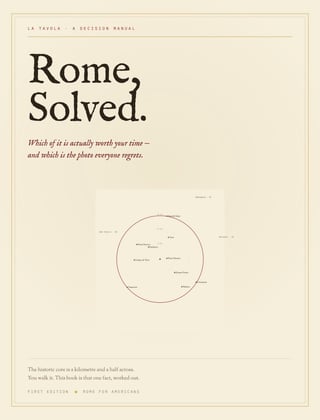
Rome's historic core is a kilometre and a half across — you walk it. That one fact decides where you sleep, whether you buy a transit pass, and how you sequence every day. Miss it and you spend the trip commuting to the city you came to see.
$34 — the book (47 pages) + the current Field Sheet
The trip doesn’t go wrong at the sights. It goes wrong in the gaps between them.
You show up at the Colosseum, the Vatican, or the Borghese expecting to buy a ticket at the door — and the one you flew across an ocean to see is sold out for your dates. No single article put those four deadlines on one calendar, so you booked the easy sight early and lost the hard one.
Or you book a room near Termini because it’s cheap and “near the transport” — not knowing the metro deliberately skirts the historic core, so you spend the trip walking in from the edge of the city you came to walk through.
Or you answer one card reader in dollars instead of euros and pay the hidden conversion markup on every purchase for a week. None of these is a single-article mistake. They live in the connections — which is exactly where the free web leaves you on your own.
The calls the trip actually turns on
Not a list of sights — the decisions that decide whether the days flow or collide, each resolved with its reasoning shown so you can follow the call or overrule it on purpose:
- Where to sleep — and why a metro address is a downgrade, not a discount.
- Whether you need a transit pass at all (your base already answered this).
- Train or the fixed-fare taxi from the airport — priced door-to-door, not by the leg.
- What “skip the line” actually skips — and the one line no ticket can.
- What to book, how far ahead — the four sights on one calendar, ranked by how early they vanish.
- The fourth day: Ostia, not Pompeii — the smarter ancient day by eleven hours.
Every claim carries its provenance
The book separates two kinds of statement. A hard fact — a fare, a rule, a distance — is marked for how solidly it’s sourced: ● established (structural, true for years), ◇ official (a regulated fare or published rule), ▲ surveyed (our own dated observation). Reasoning across those facts to reach a call carries no mark, because that judgment is ours and you’re free to argue with it.
No mark, no claim: anything we couldn’t pin was cut rather than dressed up as certain. That’s the moat — not more information, but information you can trust the weight of.
What this book won’t tell you
Four things we refuse to print — not from purity, but because faking certainty would quietly discredit everything else here:
- — No named restaurants. A restaurant pick is a guess with a byline, wrong by spring and free anywhere. We give you the rule for spotting the right one instead — it works in a neighbourhood we’ve never named.
- — No hotel list. A hotel pick is stale in a season and we haven’t slept in it. We make the decision that lasts — which area, and why — on measured walk-times.
- — No printed prices. A price in a book is a lie with a publication date. Every live figure lives on the Field Sheet, so it’s right when you read it, not when we wrote it.
A book that prints today’s prices is wrong by spring. So this one doesn’t.
The guide is two documents. The Book holds the analysis that ages slowly — the decisions, the reasoning, the geography. The Field Sheet is a dated, single-page companion carrying only the volatile figures — the current fares, booking windows, the exchange reference — refreshed on its own schedule. When the two ever disagree, the Field Sheet is the newer truth and wins.
The book (47 pages) and the current Field Sheet. Close the last tab; the trip is decided. Less than the one taxi you’d overpay for without it.