Your Rome trip begins the moment you land, and the airport-to-center transfer is the first decision where a little knowledge saves you both money and stress. Most Americans arrive at Fiumicino (Leonardo da Vinci) after a long transatlantic flight, jet-lagged and hauling luggage — not the ideal moment to be figuring out fixed fares and train platforms. So here's every realistic option, what each one costs, and which to pick depending on how you're traveling.
First, know which airport you're at. Fiumicino (FCO) is the main international hub, about 30 km southwest of the city, where nearly all transatlantic flights land. Ciampino (CIA) is the smaller airport, closer in to the southeast, used mostly by low-cost European carriers — so if you're flying in from the US, you're almost certainly at Fiumicino.
From Fiumicino (FCO)
The train: Leonardo Express
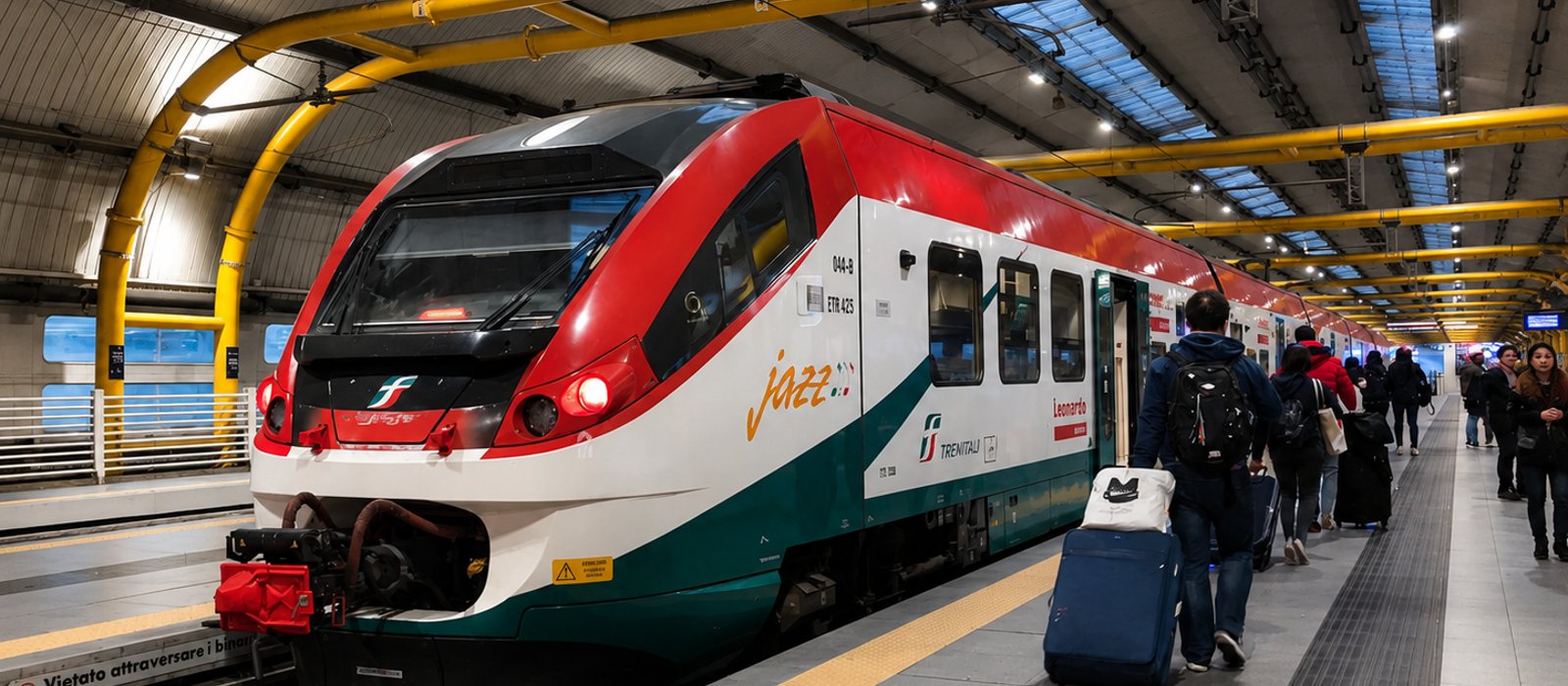
The Leonardo Express is the direct, non-stop train from Fiumicino to Roma Termini, the city's central station. It takes about 30 minutes and costs €14. Trains run frequently throughout the day, and it's the most reliable option because it sidesteps Rome's notorious traffic entirely.
This is the best choice if your accommodation is near Termini or on a Metro line, and if you can manage your luggage on a train and a short onward hop. The catch: Termini is a transit hub, not necessarily near your hotel, so factor in a taxi, Metro, or walk from the station to wherever you're staying.
There's also a cheaper regional option — the FL1 regional train (~€8) — but it does not go to Termini; it serves stations like Trastevere, Ostiense, and Tiburtina. If you're staying near one of those, it's a bargain; otherwise stick with the Leonardo Express.
The taxi: fixed fare
Official taxis from Fiumicino charge a fixed flat fare of €55 to anywhere inside the Aurelian Walls (which covers essentially all of central Rome, including the historic center, Trastevere, and the Vatican area). This rate was raised from €50 in 2026 and is set by the airport authority — it covers up to four passengers and luggage, regardless of traffic or time of day.
This is the right call if you're jet-lagged, traveling as a group or family (where €55 split is competitive), staying somewhere not near a train station, or simply want door-to-door simplicity after a long flight. The key rules: use only the official white taxis at the marked rank outside the terminal, confirm the €55 fixed fare before you set off, and insist that the meter/fixed-fare and card payment are honored. Some older articles still quote €50 — that's out of date.
A practical tip: ignore anyone inside the terminal offering you a ride. The official taxis are white, lined up at a designated rank outside, and charge the fixed fare. Touts who approach you indoors are exactly who you want to avoid.
Private transfer
A pre-booked private transfer meets you at arrivals with a name sign, handles your luggage, and takes you door to door — the most comfortable option after a transatlantic flight, especially with kids, lots of bags, or a very early arrival. Prices are dynamic and sometimes similar to, sometimes above, the €55 fixed taxi fare, so compare before booking. The upside is the guaranteed meet-and-greet and zero on-the-ground decision-making when you're exhausted.
Shuttle buses
Budget shuttle companies run from Fiumicino to Termini for roughly €6–10 per person. They're the cheapest option but the slowest and least predictable — they sit in the same traffic as taxis, take 45–60+ minutes, and run to fixed schedules. Reasonable for solo budget travelers with light luggage and time to spare; not worth it if you're tired or in a group where a split taxi costs about the same.
From Ciampino (CIA)
If you do land at Ciampino (more likely on a European budget carrier than a US flight), the fixed taxi fare is €40 to inside the Aurelian Walls. There's no direct train; the typical public route is a shuttle bus to Termini, or a bus-plus-train combination. For most travelers arriving at Ciampino, the fixed-fare taxi or a shuttle to Termini are the straightforward choices.