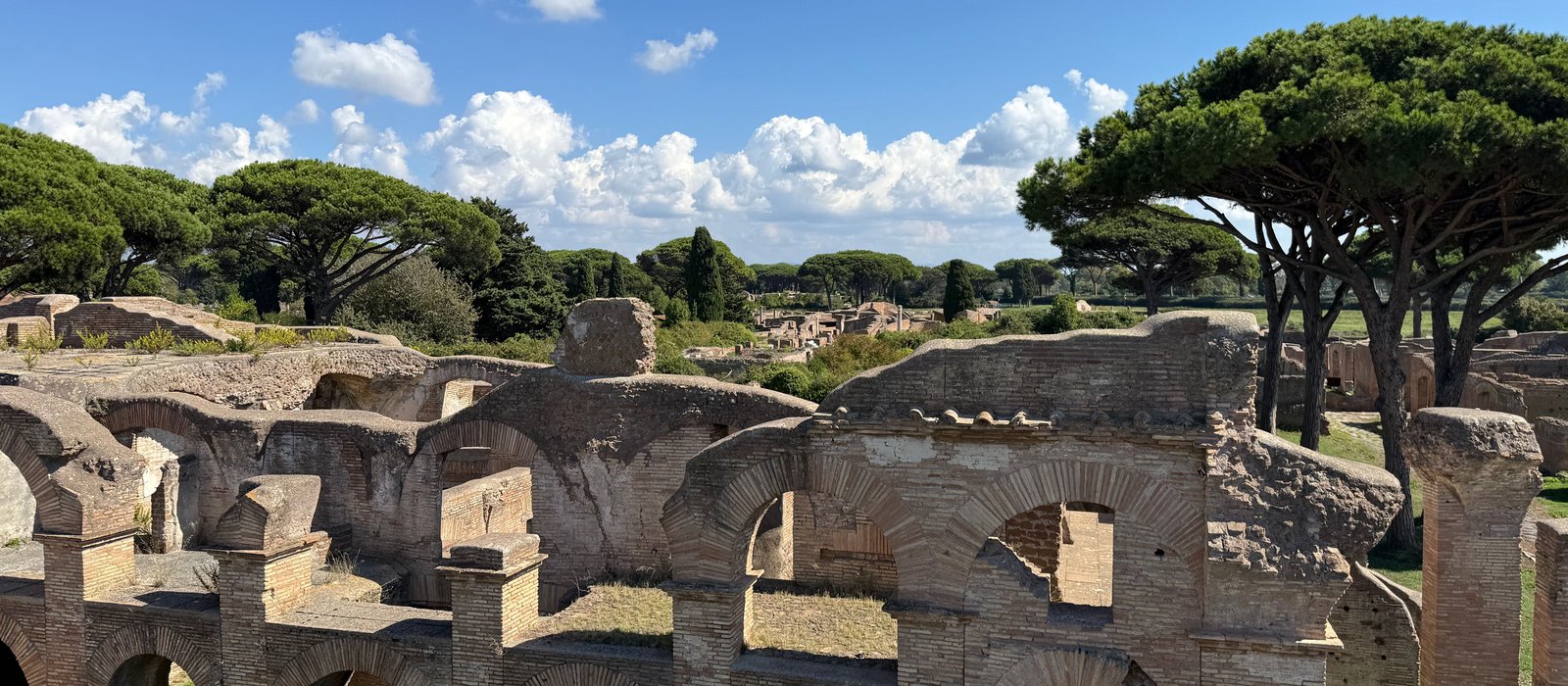
Everyone knows Pompeii — but far fewer visitors realize Rome has its own remarkably preserved ancient city right on its doorstep. Ostia Antica, the old port of Rome, is a sprawling archaeological site of streets, shops, apartment blocks, baths, temples, and astonishing mosaics, and it's reachable in about half an hour on a regular metro ticket. No high-speed train, no long haul, no crowds — just ancient Roman daily life laid out before you. For anyone who can't spare a full day for Pompeii (or simply wants a quieter, easier version), Ostia Antica is the best ancient-Rome day trip going.
Why Ostia Antica is special
Founded as Rome's harbor and naval base, Ostia grew into a bustling port city of some tens of thousands of people before silting up and being abandoned, which left it remarkably preserved. Walking it, you get something the great monuments of central Rome can't give you: the texture of an ordinary Roman city. You stroll actual paved streets past the ruins of:
- Apartment blocks (insulae) — multi-story buildings where regular Romans lived, giving a vivid sense of urban life.
- The Baths of Neptune — with spectacular black-and-white floor mosaics of sea gods and creatures.
- The theatre — a well-preserved amphitheater still used for summer performances.
- The Forum, temples, and the Square of the Corporations — with mosaics marking the ancient trading offices of merchants from across the Mediterranean.
- Shops, taverns, and a thermopolium (an ancient fast-food counter) — everyday commercial Rome.
It's often called "Rome's Pompeii," and while it wasn't frozen by a volcano, its state of preservation and the intimacy of wandering its streets earn the comparison.
A little history (why it was abandoned)
Ostia's story explains its remarkable preservation. Founded (by tradition) as Rome's first colony to guard the mouth of the Tiber, it grew over centuries into the empire's great commercial port — the place where grain from Egypt and goods from across the Mediterranean were unloaded and shipped upriver to feed the capital. At its height it was a thriving city of warehouses, merchant offices, apartment blocks, and baths. Its decline came not from disaster but from slow change: the harbor silted up, trade shifted to the newer port at Portus, the empire waned, and Ostia was gradually abandoned and buried in river mud and sand. That burial protected it — and because it was a working commercial town rather than a resort like Pompeii, it gives an unusually honest picture of ordinary Roman urban life: shops, tenements, taverns, and the offices of working merchants, rather than the villas of the rich.
Why it beats Pompeii for a short trip
Not to knock Pompeii — it's extraordinary — but for many visitors Ostia Antica is the smarter choice:
- It's close: about 30–35 minutes from central Rome, versus the ~2-hours-each-way haul to Pompeii.
- It's cheap and simple to reach (more below) — no separate intercity train booking.
- It's far less crowded, so you explore at your own pace.
- It's big enough to satisfy without being overwhelming — a half-day does it justice.
If you have a full free day and Pompeii is a bucket-list must, go to Pompeii. If you want the thrill of a preserved ancient city with minimal time and hassle, Ostia Antica wins.